Introduction
Diwali, also called Deepavali, is India’s biggest festival, known as the Festival of Lights and celebrated as a victory of light over darkness and good over evil. It is observed by Hindus, Jains, Sikhs, and some Buddhists, including Newar Buddhists. Customs vary by region and community, but lamps and gatherings bring many celebrations to life.
For people celebrating at home or learning about the festival in their community, its different traditions can offer a welcoming starting point. The festival’s shared theme connects communities whose stories and observances differ.
Key Takeaways
- Deepavali is another familiar name for the festival.
- Many Hindu traditions observe it across five days.
- Jain, Sikh, and some Buddhist observances have distinct meanings.
- Regional customs shape prayers, meals, and public celebrations.
- Lamps are a familiar symbol of light overcoming darkness.
Quick Facts
Diwali is commonly called Deepavali or Divali, and many Hindu traditions observe it across five days in Kartika. In English, Diwali is the name most often used, while Deepavali is also familiar. The Diwali festival in India brings together different religious observances, family customs, and local traditions.
Many Hindu traditions mark five days, from Dhanteras through Bhai Dooj, though communities emphasize different days. Hindus, Jains, Sikhs, and some Buddhists observe the festival. The Hindu month Kartika follows a lunar calendar, so the dates shift on the Gregorian calendar.
Five-day customs are common in many Hindu traditions, but observances differ by region and community.
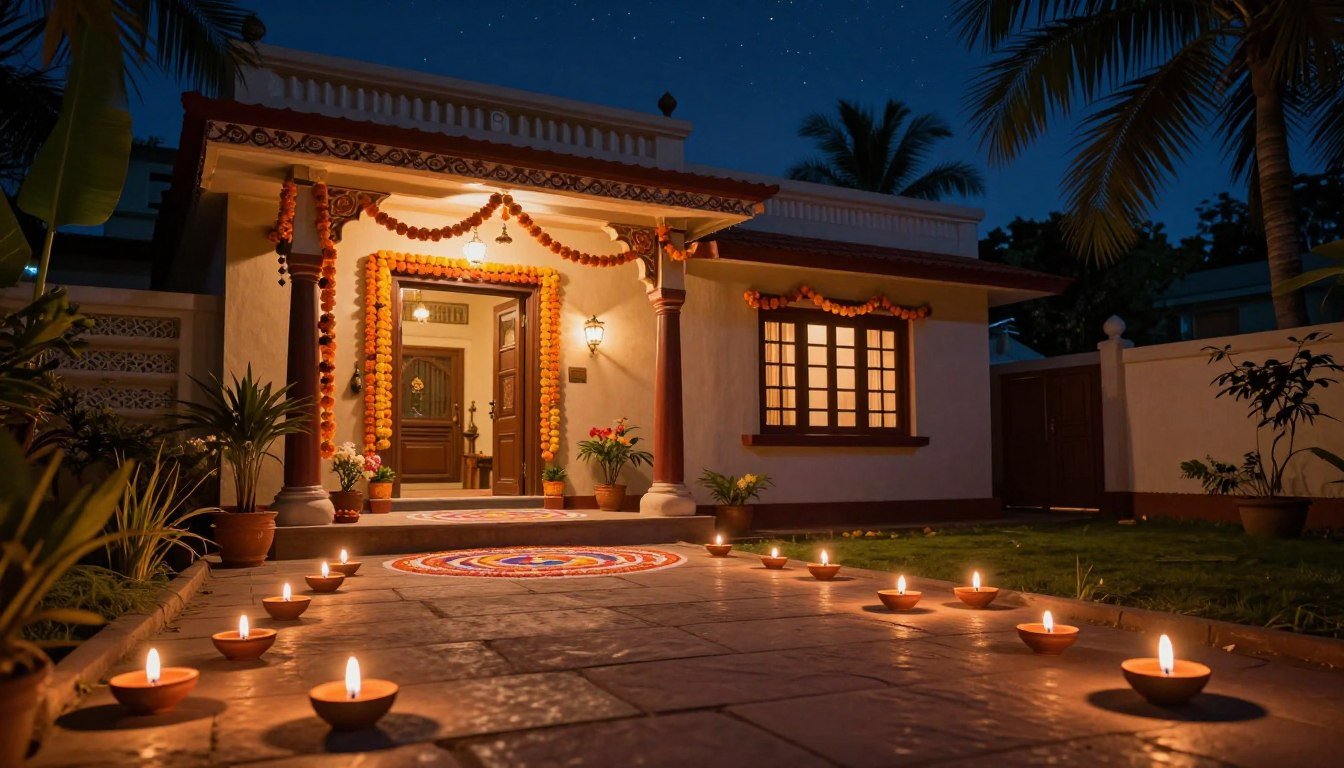
Familiar symbols include diyas, small oil lamps; rangoli, decorative floor designs; fireworks; and sweets. Some celebrations use all of them, while others focus on prayer, family time, or different community practices.
Many households light diyas near doors and windows, while rangoli may welcome visitors at an entrance. Fireworks and sweets are part of some celebrations, but not every family observes them in the same way.
Diwali Meaning and History
Deepavali means “row of lights,” a name that reflects the lamps at the heart of the celebration. Different traditions connect the festival with stories of renewal, liberation, and the triumph of good. The stories differ across communities and regions.
In a North Indian Hindu tradition, Lord Rama, Sita, and Lakshmana return to Ayodhya after 14 years of exile. People are said to have lit lamps to welcome them. This account helps explain why rows of lights are closely associated with the festival.
Many Hindu families pray to Goddess Lakshmi for prosperity and well-being during Lakshmi Puja. Goddess Lakshmi is associated with prosperity, and families traditionally worship Lord Ganesha alongside her. The prayers reflect hopes for a fortunate household and a good year ahead.
A South Indian Hindu tradition links Naraka Chaturdashi with Lord Krishna’s victory over Narakasura. The story is distinct from the North Indian account of Rama’s return, even as both connect the festival with good overcoming evil.
For Jains, Diwali marks the day Mahavira attained liberation, or nirvana. This observance honors a central event in Jain religious history, rather than the Hindu stories associated with the festival.
Sikhs observe Bandi Chhor Divas, commemorating Guru Hargobind’s release from imprisonment along with 52 other men. These distinct Hindu, Jain, and Sikh meanings share themes of liberation, renewal, and the triumph of good.
The 5 Days of Diwali
In many Hindu traditions, Diwali unfolds across five days, from Dhanteras to Bhai Dooj. Each day has its own customs, and the way families observe them varies by region and community. The sequence is customary, not identical everywhere.
Some families take part in all five observances, while others give special attention to the days most important in their local tradition. The descriptions below reflect common practices, not a schedule every household follows.
Dhanteras
Dhanteras begins the five-day sequence in many Hindu traditions. Families may buy gold, silver, utensils, or household essentials as auspicious purchases associated with prosperity. Some people also prepare their homes for the celebrations ahead, making practical purchases alongside traditional ones.
The items vary from family to family. A new utensil or household object can be a modest choice, while others mark the day with jewelry or precious metals.
Naraka Chaturdashi (Choti Diwali)
Naraka Chaturdashi, also called Choti Diwali, commemorates Lord Krishna’s victory over Narakasura in a South Indian Hindu tradition. Early-morning observances are important in parts of South India. Families may bathe early, dress for the day, and take part in local rituals.
The name Choti Diwali means “little Diwali,” but the customs can be especially meaningful where the day is a central part of the celebration. Practices differ between communities and households.
Lakshmi Puja (main Diwali day)
Lakshmi Puja is the main Diwali day in many Hindu traditions. Families light lamps, pray to Goddess Lakshmi, and gather for meals and celebrations. They may also worship Lord Ganesha alongside her as part of the household prayers.
Evening worship often gives families a moment to pause together before a shared meal. The way prayers are offered, and the timing of the gathering, can differ between homes.
Govardhan Puja
Govardhan Puja commemorates Lord Krishna lifting Govardhan Hill to protect the people of Vrindavan from torrential rain. Some observances include Annakut, a many-food offering. Families may arrange a range of dishes as an offering before sharing food.
The observance follows Lakshmi Puja in many versions of the five-day sequence. Its foods and rituals reflect local practice, so Annakut is not part of every family’s celebration.
Bhai Dooj
Bhai Dooj centers on the relationship between siblings, especially brothers and sisters. A family may mark the day with a tilak ceremony, prayers, sibling visits, and a shared meal. The gathering gives siblings a chance to spend time together after the festival’s other observances.
The five-day sequence gives families several occasions to pray, share food, and spend time together.
How Diwali Is Celebrated in India
Before the festival, many families clean and decorate their homes to prepare for guests and prayers. Festive details may include flowers, lights, and fresh designs near the entrance. Rangoli is a decorative floor design made with colored powder or rice.
Families light diyas, perform Lakshmi Puja, wear new or festive clothes, exchange gifts, visit relatives, and enjoy fireworks where they include them. These customs often come together through family visits and meals, with the details shaped by local and household traditions.
- Clean rooms and arrange flowers or other decorations.
- Place lamps around the home or near a prayer area.
- Make a rangoli design with colored powder or rice.
- Choose festive clothes for prayers and family visits.
- Share a small gift or sweets with relatives.
- Include fireworks only if they suit the household’s celebration.
A simple rangoli at the entrance is one way families make their home feel ready for the celebration.
Diwali Across Different Regions of India
The festival’s stories and customs shift across India, from Ayodhya’s Rama tradition to Kali Puja in West Bengal. Local practice shapes which rituals receive the most attention. There is no single regional pattern that represents every community.
The name Deepavali is widely used in South India, while regional celebrations elsewhere may center on other stories, prayers, or seasonal customs. These examples show some familiar traditions, not a complete account of every state or community.
North India and the return to Ayodhya
In North India, Diwali is widely associated with Rama’s return to Ayodhya. Many homes are lit with rows of diyas, echoing the lamps in the familiar story. Families may also gather for prayers and meals, with local customs shaping the details of the celebration.
The association with Ayodhya is especially prominent in this regional tradition. It sits alongside other Hindu, Jain, and Sikh observances that give the festival different meanings.
South India and Naraka Chaturdashi
In South India, Deepavali commonly centers on Naraka Chaturdashi and Krishna’s victory over Narakasura. Some families observe an early-morning oil bath and wear new clothes. These customs can be an important part of the day’s observance.
Families may also visit temples or gather at home. The timing and form of rituals vary across South Indian communities, so one household’s routine may differ from another’s.
West India, Gujarati New Year, and Maharashtra
In Gujarat, the day after Diwali is celebrated as Gujarati New Year. The timing makes the festival a point of transition into a new year for many people in the state. Families may mark the occasion with visits and local customs.
In Maharashtra, Diwali celebrations include faral, a collection of traditional festive snacks. Families may prepare or share several kinds of savory foods and sweets as part of the season’s gatherings.
East India and Kali Puja in West Bengal
In West Bengal, Kali Puja is a major Diwali observance. Devotees worship Goddess Kali at temples, and local celebrations may include decorated community pandals. The focus on Kali Puja gives the festival a distinctive expression in the region.
The contrast between regional customs is clear in these four examples:
| Region | Distinctive observance | A familiar custom |
|---|---|---|
| North India | Rama’s return to Ayodhya | Rows of diyas |
| South India | Deepavali and Naraka Chaturdashi | Early-morning oil bath in some families |
| West India | Gujarati New Year and Maharashtra’s faral | Festive snacks |
| East India | Kali Puja in West Bengal | Worship of Goddess Kali |
Regional traditions offer different ways to understand and celebrate the festival’s shared light.
Best Places to Experience Diwali in India
For a city-centered celebration, Ayodhya, Varanasi, Jaipur, Amritsar, Kolkata, and Mumbai each offer a different setting. Each destination has its own public and community observances. Choose the setting that best matches the experience you want.
These cities offer a mix of riverside ceremonies, worship, cultural programs, and seasonal shopping. Public events can draw large crowds, while neighborhood customs give each place a local feel.
- Ayodhya’s Deepotsav features diyas along the Saryu riverbank and cultural programs.
- Varanasi’s Ganges ghats glow with earthen lamps, while the evening Ganga Aarti draws crowds.
- Jaipur’s Johari Bazaar and Bapu Bazaar are decorated with festive lights.
- At Amritsar’s Golden Temple, Bandi Chhor Divas includes lighting, prayers, kirtan, and langar.
- Kolkata marks Diwali night with Kali Puja at temples and decorated community pandals.
- Mumbai’s festive markets become busy with Diwali shopping.
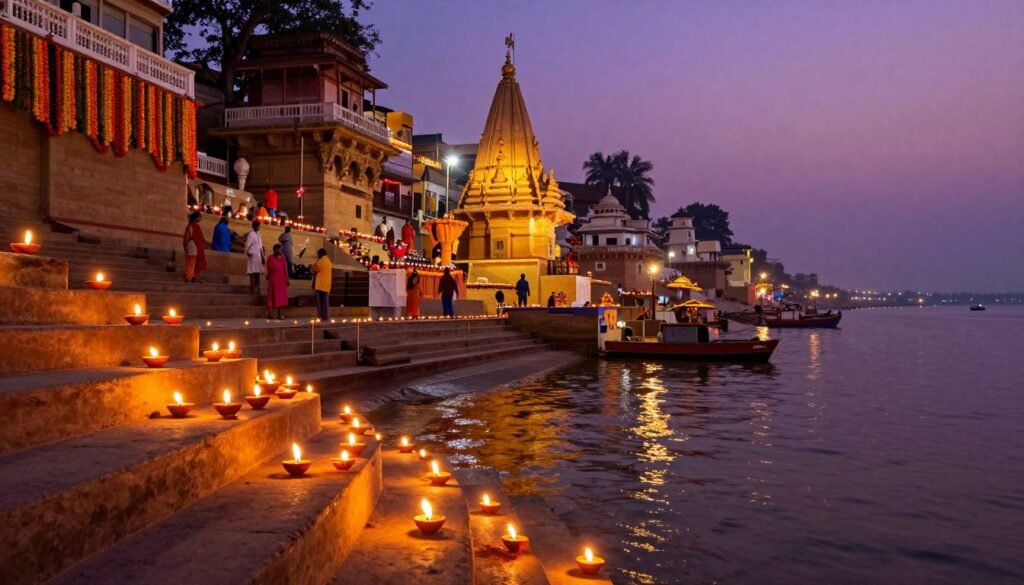
Choose a destination for the experience that matters most to you, whether it is riverside lamps, worship, or festive shopping.
Traditional Diwali Food and Sweets
Diwali meals and snack boxes often bring together sweets and savory treats from local food traditions. Familiar favorites include laddoo, kaju katli, gulab jamun, and jalebi. Recipes and food customs vary by region and household.
North Indian festive foods include laddoo, kaju katli, and mathri. South Indian sweets include Mysore pak and adhirasam. In Maharashtra, faral refers to a collection of festive snacks, including chakli and anarse.
Families may also serve other festive dishes, choosing foods that are easy to share with relatives and guests. A savory snack can balance a box of sweets, while local specialties bring a sense of home to the celebration.
| Regional food tradition | Examples | Type |
|---|---|---|
| North India | Laddoo, kaju katli, mathri | Sweets and savory snack |
| South India | Mysore pak, adhirasam | Sweets |
| Maharashtra | Faral, chakli, anarse | Festive snacks and sweets |
Sharing a small assortment lets guests sample more than one kind of festive food.
Happy Diwali Wishes and Greetings
A simple “Shubh Deepavali” is a Hindi greeting that means “Happy Diwali.” For a warmer wish, you can say, “आप सभी को खुशियों और उल्लास से भरी दिवाली की शुभ-कामनाएं,” meaning “Wishing you all a Diwali filled with happiness and joy.”
A short, personal message works well for friends, relatives, or coworkers. Copy one of these English greetings or adjust it to sound like you:
- Wishing you a bright Diwali filled with joy.
- May peace and happiness find a place in your home.
- Sending warm wishes for a beautiful festival of lights.
- May the season bring you light and time with loved ones.
- Wishing you a joyful celebration and a hopeful new year.
“Shubh Deepavali” is brief enough for a card or message, while the longer Hindi greeting offers a more detailed wish. Use the greeting that feels comfortable for your relationship and the way you usually speak.
Choose a message that sounds natural for the person and relationship you are writing to.
Celebrating a Safe and Eco-Friendly Diwali
A safer Diwali can keep the focus on light and time together while reducing avoidable risks. Fireworks are optional in some traditions, and some celebrations avoid loud displays in favor of meditation or fasting. Firecrackers can worsen air pollution.
Green crackers are promoted as a lower-emission alternative, but they do not remove the need to consider air quality. Reusable or locally made clay diyas can reduce waste, and rangoli made with natural materials offers another thoughtful choice.
Use this short checklist if fireworks are part of your plans:
- Use an open space for fireworks.
- Wear appropriate footwear.
- Avoid flammable clothing.
- Consider a quieter celebration.
If you use fireworks, light them in an open space, wear appropriate footwear, and avoid flammable clothing.
Upcoming Diwali Dates
The main Diwali day shifts on the Gregorian calendar because it follows Kartika’s new moon in the Hindu lunar calendar. Amavasya is the new moon in the Hindu lunar calendar. Diwali falls on Kartika’s Amavasya, usually between mid-October and mid-November. The listed dates are for Lakshmi Puja, the main Diwali day.
| Year | Day | Date | Observance |
|---|---|---|---|
| 2027 | Friday | October 29 | Lakshmi Puja |
| 2028 | Tuesday | October 17 | Lakshmi Puja |
| 2029 | Monday | November 5 | Lakshmi Puja |
Use the listed Lakshmi Puja date when planning around the main festival day.
Use the listed Lakshmi Puja date when planning around the main festival day.
Conclusion
Diwali brings together many ways of celebrating light, renewal, and connection. Its observances differ, yet the festival’s meaning brings many communities together around shared values. A local celebration can offer a thoughtful way to learn about those traditions.
Share a warm greeting or learn about a local observance to take part thoughtfully.